


Accesso en Español (PDF - 272 KB)
The KPDPP helps match people with kidney failure, but who do not have a living donor who matches them. In some cases, a person has someone willing to be a living donor, but they are not a match based on blood type or immune system typing.
For example, Mary wants to donate a kidney to Carlos, but they do not match. Amir wants to donate to Shauna, but they do not match. Mary is a match for Shauna, and Amir matches Carlos. Switching donors and recipients in this case allows both transplants to happen, with less risk that the recipient’s body will reject the donor’s kidney. This type of transplant is called kidney paired donation or KPD. KPD transplants can involve two or more recipient/donor pairs, resulting in more lives saved.
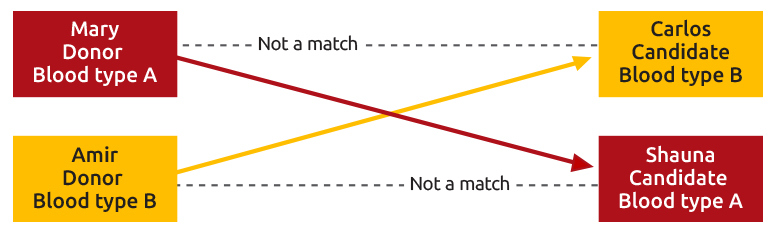
The KPDPP matches donors and candidates with other pairs who do not match. Your transplant team enters your medical information into a national database, managed by the OPTN. OPTN staff match pairs twice a week, then works with hospitals to plan the transplants.
Who can join the KPDPP?
Transplant candidates
If you need a kidney transplant, are getting care at a U.S. transplant hospital, and are on the organ transplant waitlist, you can join. You do not have to be on dialysis. You must have a living donor who is willing to donate a kidney, and the donor does not need to have your same blood type.
Donors
To be a donor, you must be at least 18 years old. You also must be willing to take part in a KPD transplant. All donors must complete medical and psychological testing before they can donate.
People who wish to donate a kidney to someone they don’t know are called non-directed, altruistic, or Good Samaritan donors. These donors enter the KPDPP alone, not as part of a pair. They may allow several transplants to happen.
How do I get started?
Contact your transplant team to ask about the KPDPP.
Learn more about living donation and transplantation:
- National Living Donor Assistance Center (NLDAC); 888-870-5002
- National Kidney Foundation
- organdonor.gov
“Being part of a KPD transplant allowed me to help my husband live a normal life. I was also able to help another family live a normal life.” - Paired exchange donor
The OPTN helps create and define organ allocation and distribution policies that make the best use of donated organs. On an ongoing basis, it evaluates new advances and discoveries so it can refine policies to best serve patients waiting for transplants. All transplant programs and organ procurement organizations throughout the country are OPTN members and must follow the policies the OPTN creates for allocating organs.
Many thanks to New England Donor Services for sharing the information and illustrations in this brochure.